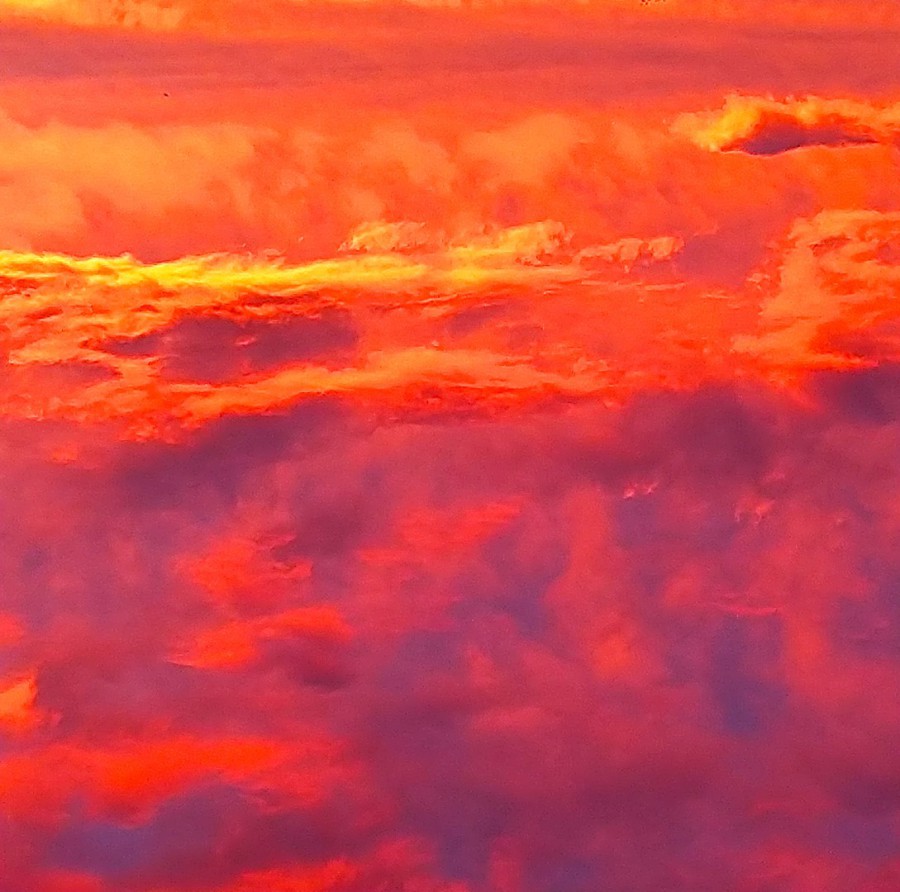
Flaming Ontology
There are beings that are things.
And there are events that exist only by losing themselves.
The flame belongs to the second kind.
It has no body — it borrows one.
No place — only a temporary address made of air.
No identity — only a continuity of transformation.
What burns does not remain.
What remains does not burn.
Classical ontology asked:
What is being?
Flaming ontology asks:
How does change hold together without becoming rigid?
A flame does not answer through stability,
but through rhythm.
It is coherence without possession.
Its edge is negotiation.
Its center is wherever energy passes through.
The organism protects itself through boundaries.
The flame exists through permeability.
It lives by not remaining with itself.
Every breath is cooperation.
Every movement a contract with the outside.
Inside and outside are only different speeds of the same process.
Fascist forms dream of the incombustible:
pure identity, cold duration, immutable shape.
The flame does not argue.
It merely shows:
Everything that becomes absolute extinguishes.
A flaming existence does not say, “I am.”
It says, “A transition is happening here.”
The subject is no longer a core,
but a zone of heightened intensity.
A self is a temperature.
Touch does not mean fusion,
but mutual ignition.
Two flames do not add together —
they modulate one another.
Community is not a bundle,
but a field of wandering luminosities.
Ethics thus becomes thermodynamic:
Not: What should I be?
But: Which fires do I nourish?
Not: Who belongs?
But: What remains capable of movement?
Good is what allows flow.
Dangerous is what becomes final.
Flaming ontology knows no ending,
only transitions of intensity.
Extinguishing is not the opposite of burning,
but its transmission.
For every flame dies only
by leaving warmth behind.
And perhaps being is nothing else
than the trace of such transmissions —
a universe of wandering embers
briefly recognizing one another
before becoming air again.
Flammende Ontologie
Es gibt Wesen, die Dinge sind.
Und es gibt Ereignisse, die nur geschehen, indem sie sich verlieren.
Die Flamme gehört zur zweiten Art.
Sie besitzt keinen Körper — sie leiht ihn sich.
Keinen Ort — nur eine vorübergehende Adresse aus Luft.
Keine Identität — nur eine Kontinuität der Verwandlung.
Was brennt, bleibt nicht.
Was bleibt, brennt nicht.
Die klassische Ontologie fragte:
Was ist ein Sein?
Die flammende Ontologie fragt:
Wie hält sich Veränderung zusammen, ohne hart zu werden?
Eine Flamme antwortet nicht durch Stabilität,
sondern durch Rhythmus.
Sie ist Kohärenz ohne Besitz.
Ihr Rand ist Verhandlung.
Ihr Zentrum ist überall dort, wo Energie übergeht.
Der Organismus schützt sich durch Grenzen.
Die Flamme existiert durch Durchlässigkeit.
Sie lebt davon, dass sie nicht bei sich bleibt.
Jeder Atemzug ist Kooperation.
Jede Bewegung ein Vertrag mit dem Außen.
Innen und Außen sind nur Geschwindigkeiten desselben Prozesses.
Faschistische Formen träumen vom Unbrennbaren:
reine Identität, kalte Dauer, unveränderliche Gestalt.
Die Flamme widerspricht nicht.
Sie zeigt lediglich:
Alles, was absolut wird, erlischt.
Eine flammende Existenz sagt nicht: „Ich bin.“
Sie sagt: „Hier geschieht gerade ein Übergang.“
Subjekt ist dann kein Kern,
sondern eine Zone erhöhter Intensität.
Ein Selbst ist eine Temperatur.
Berührung bedeutet nicht Verschmelzung,
sondern gegenseitige Entzündung.
Zwei Flammen addieren sich nicht —
sie modulieren einander.
Gemeinschaft ist kein Bündel,
sondern ein Feld wandernder Helligkeiten.
Ethik wird dadurch thermodynamisch:
Nicht: Was soll ich sein?
Sondern: Welche Feuer nähre ich?
Nicht: Wer gehört dazu?
Sondern: Was bleibt beweglich?
Gut ist, was Fluss ermöglicht.
Gefährlich ist, was endgültig wird.
Die flammende Ontologie kennt kein Ende,
nur Übergänge der Intensität.
Erlöschen ist kein Gegenteil des Brennens,
sondern seine Weitergabe.
Denn jede Flamme stirbt nur,
indem sie Wärme hinterlässt.
Und vielleicht ist Sein nichts anderes
als die Spur solcher Weitergaben —
ein Universum aus wandernden Glutresten,
die einander kurz erkennen
und wieder Luft werden.
 Druckversion